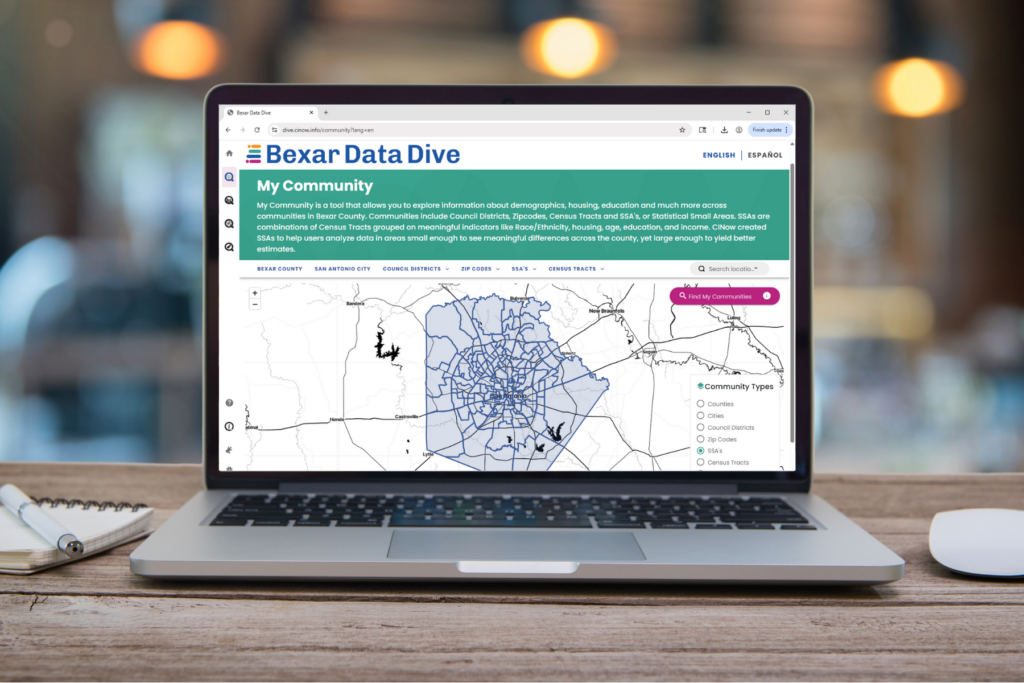

All American Community Survey (ACS) 5-year estimate indicators are now updated with the latest 2024 data on Bexar Data Dive
Why is ACS data important?
Collected by the U.S. Census Bureau, the ACS is one of the most valuable resources for social, economic, housing, and demographic data. It provides detailed insights for understanding the diverse needs and trends that shape our communities, which helps policymakers, researchers, businesses, and residents make informed decisions with community planning, resource allocation, program evaluation, and more. Learn more about ACS here [https://www.census.gov/programs-surveys/acs].
Why is the 2024 data being released now, in 2026?
ACS data is collected by sampling households across the United States over the course of the survey year. After the data is gathered, it goes through a structured process of quality control and statistical analysis. This process takes time, as the data must be thoroughly checked and refined to produce reliable estimates. Because of the complexity and volume of the data, it typically takes 12 to 18 months to process before it’s ready to release, which is why the 2024 data is being released in 2026.
How often is ACS data updated?
ACS data is updated annually with both 1-year and 5-year estimates, giving access to the most current data and information.
Until now (this latest release), consecutive 5-year estimates have always shared overlapping years (e.g., 2016-2020 and 2017-2021 both include 2017-2020). Now, four non-overlapping sets are available: 2005-09, 2010-14, 2015-19, and 2020-24).
Why use the 5-year estimates and not the 1-year estimates?
Although 1-year estimates are more current, they are not available for smaller geographies since they might not have enough data in a single year to produce reliable estimates. 5-year estimates, on the other hand, offer more detail for smaller geographies because the five-year period allows for a larger sample size by combining information spread over several years. 5-year estimates are more stable and reliable and, therefore, provide a broader picture of changes over time.
What ACS indicators are available on Dive?
Health
Environtment
Demographic
- Age groups
- Limited English proficiency
- Increase in population in past 10 years
- Race/ethnicity
- Sex
- Speak Spanish at home
- Veteran population
Education
Housing
- Home ownership (owner-occupied)
- Housing cost burden
- Owner-occupied housing cost burden
- Renter-occupied housing cost burden
- Change in total housing units (10-year change)
- Multi-family housing units
- Renter housing stability (moved in past year)
- Vacant housing units
- Geographic mobility (moved in the past year)
Economic
- Computer and broadband subscription
- Employed
- Unemployed
- Not in labor force
- Income inequality (Gini index)
- Family income (median)
- Household income (median)
- Households with income <30% AMI
- Households with income <60% AMI
- Households with income <80% AMI
- Population in armed forces
- Income below poverty
- Supplemental Security Income (SSI)
- Uninsured
- Youth not in school or not working