

Analyzing Bexar County’s residential landscape and community impacts
The lack of local data on housing has made it difficult to design targeted policies to address housing challenges and prevent resident displacement, particularly around new amenities. We are working to understand how residential property ownership shapes housing affordability, neighborhood change, community stability, and related health and safety issues in Bexar County.
Across several ongoing and recently funded projects, we are building and sharing data on investor-owned properties, ownership patterns by property type and neighborhood, and related housing pressures such as rising property taxes and tax foreclosure. Through partnerships with organizations like NNIP, the Asset Funders Network, and other national and local collaborators, this work aims to inform community conversations, support policy solutions, and help protect housing opportunities for local residents.
Read more about our ongoing work below, and reach out using the contact form if you have questions or are interested in contributing to the research.
2024 NNIP Emerging Opportunities Fund
We are analyzing investor and absentee investor ownership of residential properties in Bexar County, as recent data shows a significant portion of homes are being sold to buyers not intending to make them their primary residence. This trend, which includes both local and absentee investors, has contributed to a tightening housing market, with median home prices more than doubling in the past decade.
As investor activity increases, rising home values and the growing displacement risks for long-time residents have become pressing concerns. Addressing these challenges requires stronger local data to better understand who owns residential properties, where investor-owned properties are concentrated, and how ownership patterns intersect with neighborhood well-being.
This research allowed us to analyze absentee investor-owned residential property to address the negative impact on affordable housing in Bexar County. In the short term, the goal was to raise awareness among the community, policymakers, and funders about the problem and build support for better data. In the longer term, the aim is to encourage local action against absentee ownership and provide data to help protect properties for local residents.
So far, progress includes securing funding to expand the analysis, partnering with key organizations like the Asset Funders Network and H. E. Butt Foundation, and sharing findings with groups like LISC San Antonio.
This research was supported by a 2024 grant from the National Neighborhood Indicators Partnership (NNIP) Emerging Opportunities Fund.
Learn more about the 2024 NNIP Emerging Opportunities Fund, including the other funded projects, here.
San Antonio Area AFN Homeownership Investment
This work aims to learn more about all investor-owned residential properties, not just absentee investor-owned. It also ties into the San Antonio Area chapter of AFN’s focus on supporting access to quality affordable housing through creating and sharing knowledge and putting that knowledge to work through innovative practices and collaborative initiatives.
Our work is focused on identifying what proportion of residential properties—such as single-family homes, multi-family units, and vacant lots—are held by investors and whether these properties are concentrated in specific neighborhoods or near amenities like the Green/Silver line routes.
We are also trying to understand the distribution of investor-owned properties in terms of race/ethnicity and income. By analyzing the characteristics of investors, such as where they live and how many properties they own, we hope to inform policy solutions that address the impact of investor ownership on the local housing market and community well-being.
This research is supported by the San Antonio Area Chapter of the Asset Funders Network (SAA AFN).
Learn more about SAA AFN and their work on the 2024 Shared Equity Homeownership Series on their website: https://assetfunders.org/regional-chapter/san-antonio/.
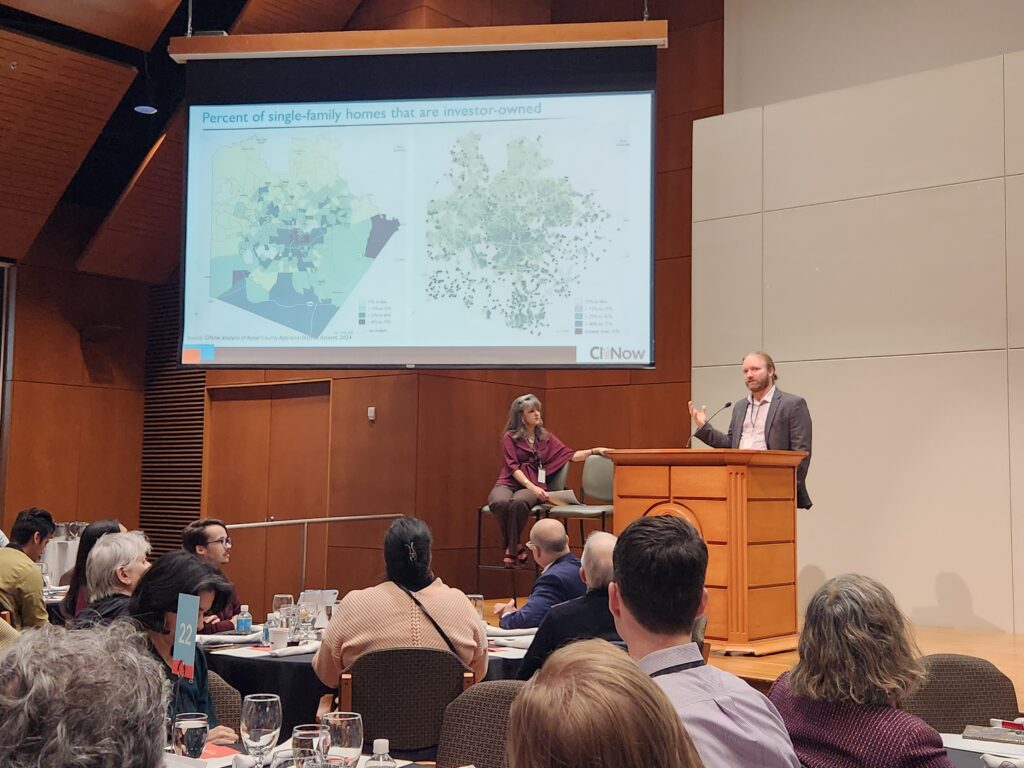
We hosted a breakout session at the “Everyone Needs a Home” housing summit during Dream Week San Antonio #WeAreNeighbor, titled “Following the Money: Who Owns San Antonio? And Where Did They Go?” to present early findings.
At the housing summit series (on 02/10, hosted by the H.E. Butt Foundation), we led a breakout session focused on who owns residential properties in San Antonio and how it affects housing challenges like displacement. There’s a lack of local data on absentee and investor ownership, which makes it difficult to design policy and system solutions to fit and address various versions of the problem.
For the session presentation, Laura McKieran (Executive Director) and Jeremy Pyne (Project Manager) shared our early findings on ownership patterns in San Antonio. 👏🏽
A special thank you to the Asset Funders Network (AFN) for supporting this important work and to the H. E. Butt Foundation for inviting us to be part of such a crucial conversation.
The presentation slides from our breakout session at the “Everyone Needs a Home” summit are now available in PDF format. They provide a deeper look at our preliminary findings on property ownership patterns in San Antonio, as shared during the session. Click here to download.

2026 Local Data for Equitable Communities Grant
Too many San Antonians lose their homes because of late or unpaid property tax payments—even when those homes have been in families for generations. This project uses mixed methods to understand how common tax foreclosures are, the amount of delinquent taxes owed by owners who lose their properties, and the drivers of tax foreclosure to inform practitioners and policymakers in crafting strategies to prevent tax foreclosure.
Because Texas has no income tax, property taxes are a major source of funding for schools, public services, and infrastructure. As people with higher incomes have moved into Bexar County and investor activity has spiked, a tightening housing market and rising property values have driven a sharp increase in property tax bills without a parallel increase in wealth for long-time residents. Neighborhood revitalization and gentrification are also drivers of rising property values and tax valuations.
Tax foreclosures have become common and disproportionately clustered in low- and moderate-income areas of Bexar County, where properties are more likely to be owned free and clear. As part of this currently ongoing project, we are gathering quantitative (numerical summations) and qualitative (focus groups and lived experiences) data to better understand foreclosure in Bexar County and how to prevent it.
A collaboration between the Robert Wood Johnson Foundation and the Urban Institute, this research is supported by the 2026 Local Data for Equitable Communities grant.
View the project on the grantee website and explore other funded projects, here.
Related Work from NNIP and Urban Institute
This section highlights related work from our partners at NNIP and the Urban Institute, offering valuable insights into investor-owned housing and community-based research. All linked works can be accessed by clicking on the titles below.
- NNIP partners explore investor-owned housing
Urban Institute, September 2024 - Community based research in action: Maximizing community benefit, repairing historical harm and preventing displacement about the blue line light rail extension
Center for Urban and Regional Affairs (Minneapolis-St. Paul), November 2023 - Single family rental investor ownership in Kansas City
The Mid-America Regional Council (Kansas City), March 2024 - Facing more investor purchases, Charlotte considers tweaking housing programs
UNC Charlotte Urban Institute (Charlotte), March 2022 - Institutional owners in single-family rental properties: A review of the federal and local regulation and policy landscape
Urban Institute, August 2023